Experience Is Not a Methodology
|
Welcome to the Mellow Madness update, a space for thinking out loud about strategy, leadership, and the lessons business sometimes teaches us when we least expect them.
There comes a point in your career when you become so familiar with your work that certain decisions feel almost instinctive. You can walk into a meeting, listen to a challenge and quickly begin connecting the dots. Years of experience have taught you what to look for, what questions to ask and sometimes which mistakes to avoid. But what happens when someone asks you to explain exactly how you arrived at your recommendation?
I have spent more than two decades working across brand strategy, brand development, strategic and executive communications, and advertising, having started my professional journey as an award-winning graphic designer. Over the years, I have learnt that experience gives you confidence and judgement, but there is something equally important: the ability to explain your thinking. It is one thing to know how to solve a problem. It is another to demonstrate a clear process that others can understand, trust and even replicate.
Recently, I have been revisiting some of the frameworks and methodologies used in strategic communications. Not because the principles are new to me, but because I believe even experienced professionals need to sharpen how they articulate what they know. Sometimes we become so comfortable doing the work that we forget the importance of explaining the thinking behind it. And as our responsibilities grow, that explanation becomes increasingly important.
Think about a skilled carpenter in one of our African communities. After thirty years of working with wood, he can probably identify good timber by simply looking at it. He knows where to cut, how to shape it and what will last. But when a young apprentice joins him, instinct alone is not enough. He must explain his process. Otherwise, his knowledge remains locked inside his own experience.
|
 |
The same applies to business.
Imagine a company approaches you asking for a communications campaign because it wants more visibility. You could immediately recommend advertising, social media or public relations. But a strategic communicator should first ask why visibility matters. Is the company trying to enter a new market? Attract investors? Build customer trust? Increase sales? The answers determine the strategy, because communication should always serve a business objective, not simply create activity.
This is where I believe the relationship between business strategy and communications becomes particularly important. Business strategy establishes where an organisation wants to go, while communications helps people understand that direction, believe in it and act upon it. The two should never operate in isolation. A brilliant business strategy that is poorly communicated can struggle to gain support, just as excellent communication cannot compensate for a weak business strategy. The real value lies in connecting the two.
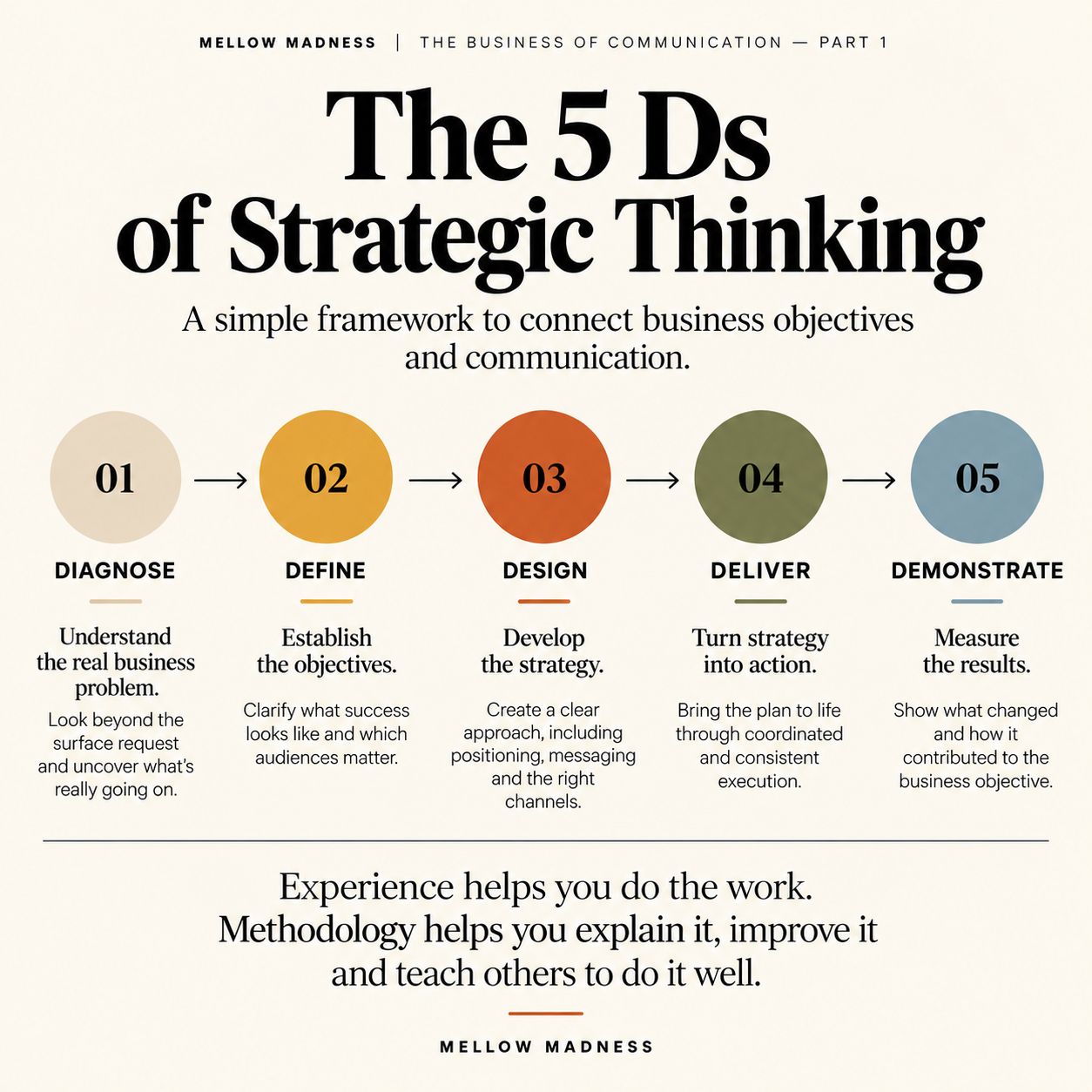
This is also why having a clear methodology matters. In my work, I find it useful to think through five stages: diagnose the problem, define the objectives, design the strategy, deliver the solution and demonstrate the results. It is not a rigid formula, but a way of ensuring that the work remains connected to the challenge we are trying to solve. More importantly, it allows us to explain why we are recommending a particular course of action rather than simply asking people to trust our experience.
The more I think about it, the more I realise that this is also a leadership lesson. When you are starting out, people may judge you by the quality of what you produce. As you grow into leadership, they also need to understand why you make certain decisions, how you assess risks and how your recommendations contribute to the bigger picture. You are no longer responsible only for doing excellent work, but also for helping others do excellent work.
This matters particularly for African businesses, where so much valuable knowledge has been built through practical experience. We have brilliant entrepreneurs and professionals who understand their markets exceptionally well, yet some of that knowledge remains undocumented and difficult to transfer. If we want to build businesses that grow beyond their founders, we must become better at turning individual expertise into systems that others can learn from.
|
 |
|
|
For me, revisiting these frameworks is not about collecting impressive business terminology. It is about becoming more deliberate in how I communicate the value of my work. After all, learning should not stop simply because we have accumulated years of experience. If anything, experience should give us more reasons to remain curious.
Over the next few weeks, I will be sharing reflections on the relationship between business objectives and communications, exploring how organisations develop messages, manage reputation, navigate crises and measure whether their communication is actually making a difference.
Because at the end of the day, experience helps you do the work. Methodology helps you explain it, improve it and teach others to do it well.
And perhaps that is one of the most important transitions we make as we grow from practitioners into leaders.
Thank you for reading,
Warm regards.
|
|
|
|
|
If someone forwarded this note to you and you’d like to receive future issues, you can subscribe here:
|
|
|
|
|
|
|

